
Situation at a glance
Between 1 January and 27 September 2022, a total of 25 932 confirmed dengue cases and 62 deaths (CFR 0.25%) were reported in Pakistan, with 74% of these cases reported in the month of September alone. The current surge in cases follows unprecedented flooding that began in mid-June 2022. With the current flood crisis affecting the national health system capacity and the growing humanitarian situation, there is a high risk of serious health impacts from dengue fever and other concurrent disease outbreaks. High population movement between Pakistan and bordering countries (in particular, Afghanistan and the Islamic Republic of Iran) means that the international transmission of dengue fever cannot be ruled out.
Epidemiology of dengue
Dengue is a viral infection transmitted by mosquitoes caused by four types of dengue virus (DENV 1, DENV 2, DENV 3, DENV 4). Infection with one serotype provides long-term immunity to the homologous serotype, but not to other serotypes; sequential infections put people at greater risk of severe dengue. DENV can cause an acute flu-like illness, many DENV infections produce only mild illness; over 80% of cases are asymptomatic.There is no specific treatment for dengue, however, timely detection of cases, identifying any warning signs of severe dengue infection, and appropriate case management are key elements of care to prevent patient death and can lower fatality rates of severe infection to below 1%.Dengue fever is endemic in Pakistan, with seasonal outbreaks and the circulation of the four Serotypes in different areas of the country. Aedes aegypti and Aedes albopictus are widely adapted vectors for urban and peri-urban environments. As dengue is recurrent in the country, the population may be at risk of re-infection and therefore, serious complications may occur if not managed promptly and correctly.
Symptoms
Mild symptoms of dengue can be confused with other illnesses that cause fever, aches and pains, or a rash.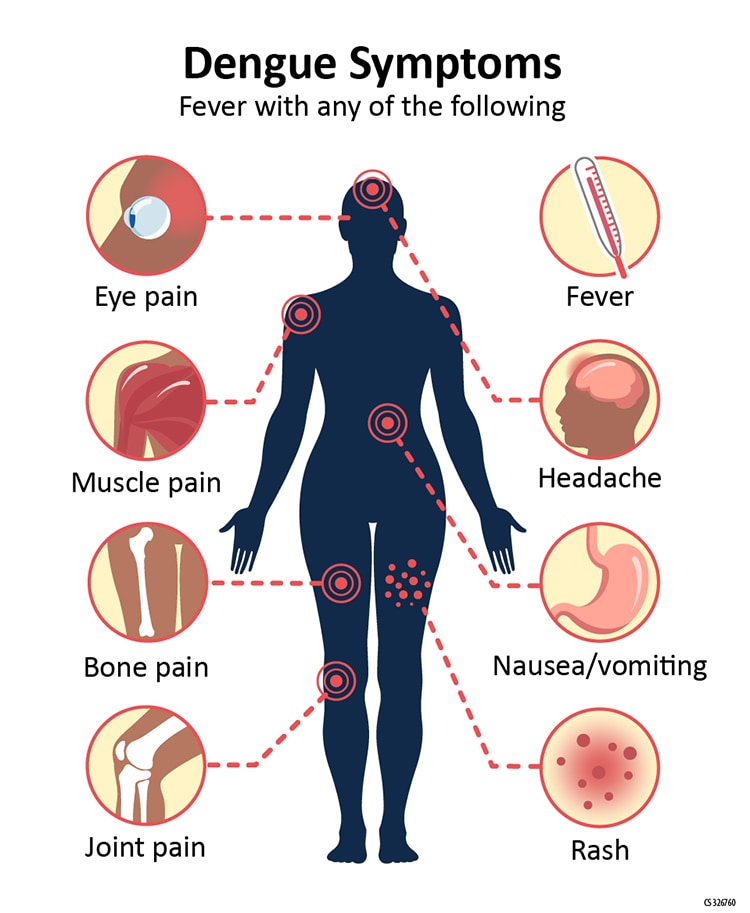 The most common symptom of dengue is fever with any of the following:Nausea, vomiting Rash Aches and pains (eye pain, typically behind the eyes, muscle, joint, or bone pain) Any warning sign Symptoms of dengue typically last 2–7 days. Most people will recover after about a week.
Treatment
There is no specific medicine to treat dengue. Treat the symptoms of dengue and see your healthcare provider.
Testing for Dengue
CDC recommends dengue virus testing for:
- Anyone who lives in or traveled to areas where dengue virus is transmitted and has recently experienced signs and symptoms of dengue illness.
- Signs and symptoms of dengue may include fever, headache, rash, body aches, and bleeding manifestations. Symptoms may be mild or severe. Severe dengue often requires hospitalization. Dengue can occasionally present with signs and symptoms of aseptic meningitis or encephalitis.
Dengue virus testing is not recommended for:
- Asymptomatic patients
- Preconception screening
Patients with symptoms consistent with dengue can be tested with both molecular and serologic diagnostic tests during the first 7 days of illness. After the first 7 days of illness, test only with serologic diagnostic tests.
Diagnostic Tests for Dengue and Specimens
| Diagnostic Test | ≤7 Days After Symptom Onset | >7 Days Post Symptom Onset | Specimen Types |
|---|---|---|---|
| Molecular Tests | ✓ | — | Serum, plasma, whole blood, cerebrospinal fluid* |
| Dengue Virus Antigen Detection (NS1) | ✓ | — | Serum |
| Serologic Tests | ✓ | ✓ | Serum, cerebrospinal fluid* |
| Tissue Tests | ✓ | ✓ | Fixed tissue |
* Testing cerebrospinal fluid is recommended in suspect patients with central nervous system clinical manifestations such as encephalopathy and aseptic meningitis.
Acute Phase: Initial 1-7 days after symptom onset
- The initial 1-7 days after symptom onset are referred to as the acute phase of dengue.
- During this period, dengue virus is typically present in blood or blood-derived fluids such as serum or plasma.
- Dengue virus RNA can be detected with molecular tests.
- The non-structural protein NS1 is a dengue virus protein that also can be detected using some commercial tests.
- A negative result from a molecular or NS1 test is not conclusive. For symptomatic patients during the first 1-7 days of illness, any serum sample should be tested by a NAAT or NS1 test and an IgM antibody test. Performing both molecular and IgM antibody (or NS1 and IgM antibody) tests can detect more cases than performing just one test during this time period, and usually allows diagnosis with a single sample.
Convalescent Phase: >7 days post symptom onset
- The period beyond 7 days following symptom onset is referred to as the convalescent phase of dengue.
- Patients with negative NAAT or NS1 test results and negative IgM antibody tests from the first 7 days of illness should have a convalescent sample tested for IgM antibody test.
- During the convalescent phase, IgM antibodies are usually present and can be reliably detected by an IgM antibody test.
- IgM antibodies against dengue virus can remain detectable for 3 months or longer after infection.
- Patients who have IgM antibodies against dengue virus detected in their serum specimen with an IgM antibody test and either: 1) have a negative NAAT or NS1 result in the acute phase specimen, or 2) without an acute phase specimen, are classified as having a presumptive, recent dengue virus infection.
Testing to differentiate dengue from other flaviviruses
Special considerations:
- Cross reactivity: Cross reactivity is a limitation of dengue serologic tests. Serologic tests to detect antibodies against other flaviviruses such Japanese encephalitis, St. Louis encephalitis, West Nile, yellow fever, and Zika viruses may cross react with dengue viruses. This limitation must be considered for patients who live in or have traveled to areas where other flaviviruses co-circulate. Therefore, a patient with other recent or past flavivirus infection(s) may be positive when tested to detect IgM antibodies against dengue virus. To more precisely determine the cause of infection in IgM positive patients, the IgM-positive specimens can be tested for specific neutralizing antibodies by plaque reduction neutralization test (PRNT) (against the four dengue virus serotypes and other flaviviruses; however, PRNT does not always conclusively distinguish specific flaviviruses.
- Areas with co-circulating flaviviruses: For people living in or traveling to an area with endemic or concurrently circulating dengue, Zika, and other flaviviruses, clinicians will need to order appropriate tests to best differentiate dengue virus from other flaviviruses, and may consult with state or local public health laboratories or CDC for guidance.
- Pregnant women: If the patient is pregnant and symptomatic and lives in or has traveled to an area with risk of Zika, test for Zika using NAAT in addition to dengue.
Interpreting test results
- If a NAAT or NS1 test is positive for dengue, a current dengue diagnosis is confirmed.
- If the NAAT result is negative and the IgM antibody test is positive, the laboratory diagnosis is presumptive dengue virus infection.